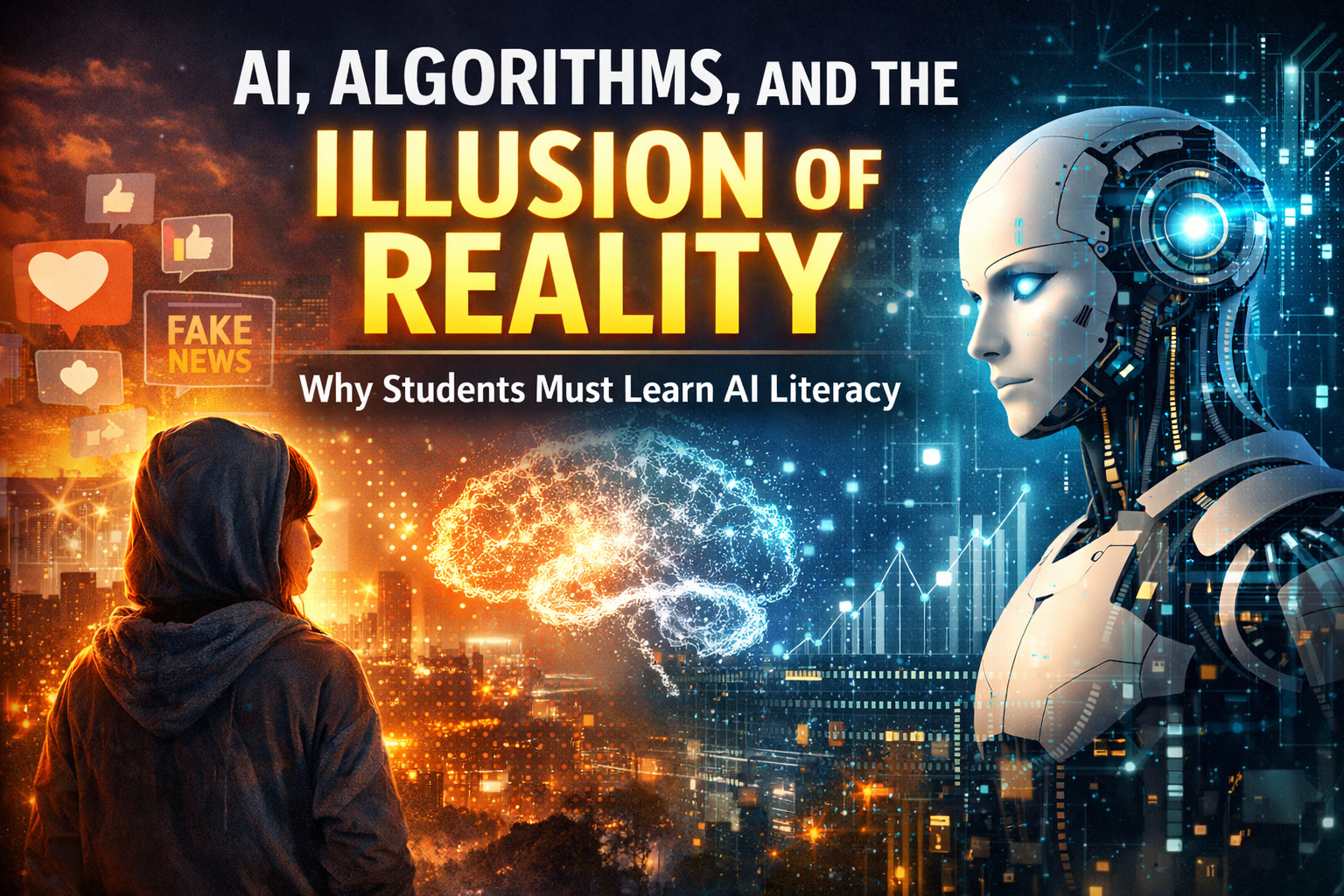
<p data-start="86" data-end="517">Artificial Intelligence is rapidly becoming a part of our everyday lives. From AI chatbots helping students with homework to social media algorithms deciding what content appears in our feeds, technology is constantly shaping how we access and understand information. While these tools offer convenience and efficiency, they also raise an important question: <strong data-start="445" data-end="517">Are we seeing reality, or a version of reality shaped by algorithms?</strong></p><p data-start="519" data-end="725">For students and educators, this distinction is becoming increasingly important. As AI tools become more integrated into learning environments, developing <strong data-start="674" data-end="711">AI literacy and digital awareness</strong> is essential.</p><hr data-start="727" data-end="730"><h3 data-start="732" data-end="769">The Algorithmic View of the World</h3><p data-start="771" data-end="1083">Most online platforms rely heavily on algorithms to personalize content. These systems analyze user behavior—such as likes, clicks, and watch time—to determine what appears on a user’s feed. While this improves engagement, it also means that the information people see is often <strong data-start="1049" data-end="1082">a filtered version of reality</strong>.</p><p data-start="1085" data-end="1364">For example, social media algorithms tend to promote content that generates strong reactions. Controversial or extreme opinions often receive more engagement and therefore become more visible. Over time, this can make certain viewpoints appear more common than they actually are.</p><p data-start="1366" data-end="1487">For students who rely on digital platforms for news and information, this can create a distorted perception of the world.</p><hr data-start="1489" data-end="1492"><h3 data-start="1494" data-end="1537">How AI Influences Language and Thinking</h3><p data-start="1539" data-end="1794">AI chatbots like ChatGPT are widely used for writing assistance, explanations, and research. These systems generate responses based on patterns learned from large datasets. However, this process can sometimes amplify certain linguistic patterns or biases.</p><p data-start="1796" data-end="2051">Interestingly, researchers have observed that certain words appear more frequently in AI-generated responses than in everyday conversation. As more people interact with AI systems, these patterns can subtly influence how individuals write and communicate.</p><p data-start="2053" data-end="2269">This creates a feedback loop: <strong data-start="2083" data-end="2169">AI learns from human language, and humans begin adapting to AI-generated language.</strong> Over time, the distinction between natural and machine-influenced communication becomes less clear.</p><hr data-start="2271" data-end="2274"><h3 data-start="2276" data-end="2316">Why AI Literacy Matters in Education</h3><p data-start="2318" data-end="2575">AI systems are powerful, but they are not neutral. Their outputs depend on training data, design decisions, and platform incentives. Companies often optimize algorithms to increase engagement or revenue, which can influence what information becomes visible.</p><p data-start="2577" data-end="2716">Because of this, students need more than just technical skills—they need <strong data-start="2650" data-end="2715">critical thinking skills to question AI-generated information</strong>.</p><p data-start="2718" data-end="2788">Educators can encourage students to ask simple but powerful questions:</p><ul data-start="2790" data-end="2922">
<li data-start="2790" data-end="2821">
<p data-start="2792" data-end="2821">Why am I seeing this content?</p>
</li>
<li data-start="2822" data-end="2873">
<p data-start="2824" data-end="2873">What data might have influenced this AI response?</p>
</li>
<li data-start="2874" data-end="2922">
<p data-start="2876" data-end="2922">Are there other perspectives I should explore?</p>
</li>
</ul><hr data-start="2924" data-end="2927"><h3 data-start="2929" data-end="2974">Preparing Students for an AI-Driven World</h3><p data-start="2976" data-end="3148">Artificial intelligence will continue to shape the future of education and information. The goal is not to avoid AI tools, but to use them <strong data-start="3115" data-end="3147">thoughtfully and responsibly</strong>.</p><p>
</p><p data-start="3150" data-end="3438" data-is-last-node="" data-is-only-node="">By teaching students to understand how algorithms work and how AI influences information, educators can help them become more informed and independent thinkers. In an increasingly algorithm-driven world, <strong data-start="3354" data-end="3438" data-is-last-node="">AI literacy is becoming a fundamental skill for the next generation of learners.</strong></p>