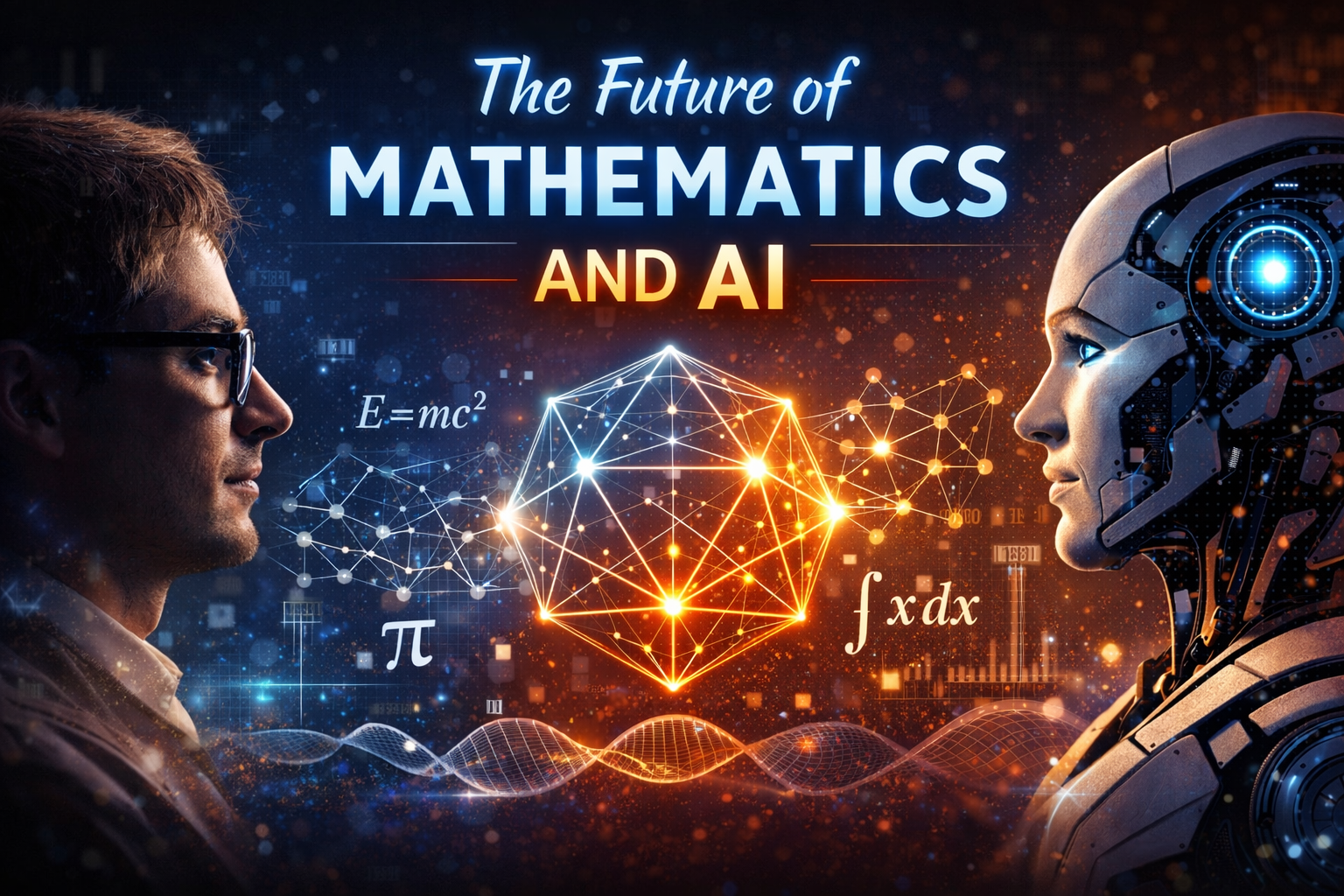
<p class="p1">For centuries, mathematics has been regarded as the purest form of human reasoning. It was built slowly, methodically, from axioms and proofs. It demanded rigor, patience, and deep abstraction. But today, something remarkable is happening. Artificial Intelligence is beginning to influence how mathematics is explored, verified, and even discovered.</p><p class="p1">This shift is not about machines replacing mathematicians. It is about redefining what collaboration between humans and intelligent systems can look like.</p><p class="p1">And the implications extend far beyond mathematics — they reach into the core of education itself.</p><p></p><p class="p3"><span class="s1"></span></p><h2><b>Mathematics Has Always Been More Experimental Than We Admit</b></h2><p class="p1">We often imagine mathematics as perfectly structured: definitions followed by proofs, all moving in a straight logical line. But that is only part of the story.</p><p class="p1">In reality, much of mathematics begins experimentally. Mathematicians compute values, look at patterns, test examples, and explore structures before they ever attempt a formal proof. Many historic breakthroughs started as observations — someone noticing that numbers behaved in a particular way and wondering why.</p><p class="p1">Today, AI is dramatically accelerating this exploratory phase.</p><p class="p1">With the ability to process massive datasets and identify subtle patterns, machine learning systems can uncover mathematical relationships that would take humans years to detect. In some recent cases, AI systems have proposed entirely new conjectures — statements that experts are still trying to prove or disprove.</p><p class="p1">This suggests that discovery itself may be entering a new era.</p><p class="p3"><span class="s1"></span></p><p></p><p class="p3"><span class="s1"></span></p><h2><b>From Proof Checkers to Discovery Partners</b></h2><p class="p1">AI’s first major contributions to mathematics focused on verification. Proof assistants can formalize arguments line by line, ensuring there are no logical inconsistencies. Entire libraries of undergraduate mathematics have been translated into machine-verifiable code.</p><p class="p1">This matters because even the most carefully reviewed human work can contain subtle gaps. Machines excel at consistency and precision.</p><p class="p1">But the field is now moving beyond verification.</p><p class="p1">Large language models, trained on vast amounts of mathematical literature, are starting to assist with reasoning. In structured evaluations, advanced models have successfully solved challenging competition-level problems and are beginning to engage with research-level questions.</p><p class="p1">While they are far from independently solving the deepest open problems in mathematics, they are no longer trivial tools. They are collaborators.</p><p></p><p class="p3"><span class="s1"></span></p><h2><b>What This Means for How We Learn</b></h2><p class="p1">If AI can assist in advanced mathematical discovery, what does that imply for everyday learning?</p><p class="p1">First, it reshapes how students interact with complex subjects. Instead of passively consuming explanations, learners can engage dynamically — testing ideas, asking follow-up questions, and exploring alternative approaches instantly.</p><p class="p1">Second, AI enables a more personalized experience. Just as neural networks adapt to patterns in mathematical data, adaptive learning systems can tailor educational pathways to individual strengths and weaknesses.</p><p class="p1">Third, it shifts the role of the educator. Teachers are no longer simply transmitters of information. They become guides who help students interpret, question, and refine AI-assisted insights.</p><p class="p1">In this environment, critical thinking becomes more important, not less.</p><p></p><p class="p3"><span class="s1"></span></p><h2><b>AI Does Not Replace Mathematical Thinking</b></h2><p class="p1">There is a tendency to frame AI as a threat to human intellectual work. In mathematics, this fear is misplaced.</p><p class="p1">Mathematical discovery requires intuition, creativity, and conceptual framing. AI may detect patterns, but deciding which patterns matter — and why — remains a human responsibility.</p><p class="p1">When AI proposes a conjecture, mathematicians must still evaluate its significance. When AI produces a proof sketch, experts must assess its rigor.</p><p class="p1">The future is not about automation. It is about augmentation.</p><p></p><p class="p3"><span class="s1"></span></p><h2><b>A Broader Shift in Knowledge Creation</b></h2><p class="p1">Mathematics often serves as a preview of what will happen in other domains. Because it demands absolute rigor, any meaningful AI integration there signals deep capability.</p><p class="p1">If intelligent systems can now contribute to structured reasoning in mathematics, similar transformations are likely in fields such as science, engineering, economics, and even philosophy.</p><p class="p1">For education platforms and institutions, this means preparing learners not just to use AI tools, but to think alongside them.</p><p class="p1">Students must learn how to:</p><p class="p3"><span class="s1"></span></p><ul><li>
<p class="p1">Question AI-generated outputs</p>
</li><li>
<p class="p1">Validate reasoning</p>
</li><li>
<p class="p1">Interpret results</p>
</li><li>
<p class="p1">Combine computational power with conceptual understanding</p></li></ul><p class="p1">The skill of the future is not memorization. It is structured reasoning supported by intelligent systems.</p><p></p><p class="p3"><span class="s1"></span></p><h2><b>The Human–AI Partnership Era</b></h2><p class="p1">We are entering a period where mathematics is being reshaped by collaboration between human intellect and machine intelligence. It is one of the most exciting intellectual developments of our time.</p><p class="p1">For education, the message is clear: AI will not diminish the importance of foundational thinking. It will demand it at a higher level.</p><p class="p1">Those who understand both the logic of mathematics and the mechanics of AI will be positioned to lead in this new era of discovery.</p><p>
</p><p class="p1">The transformation has already begun. The question is not whether AI will influence learning and knowledge creation. The question is how quickly education systems will adapt.</p>